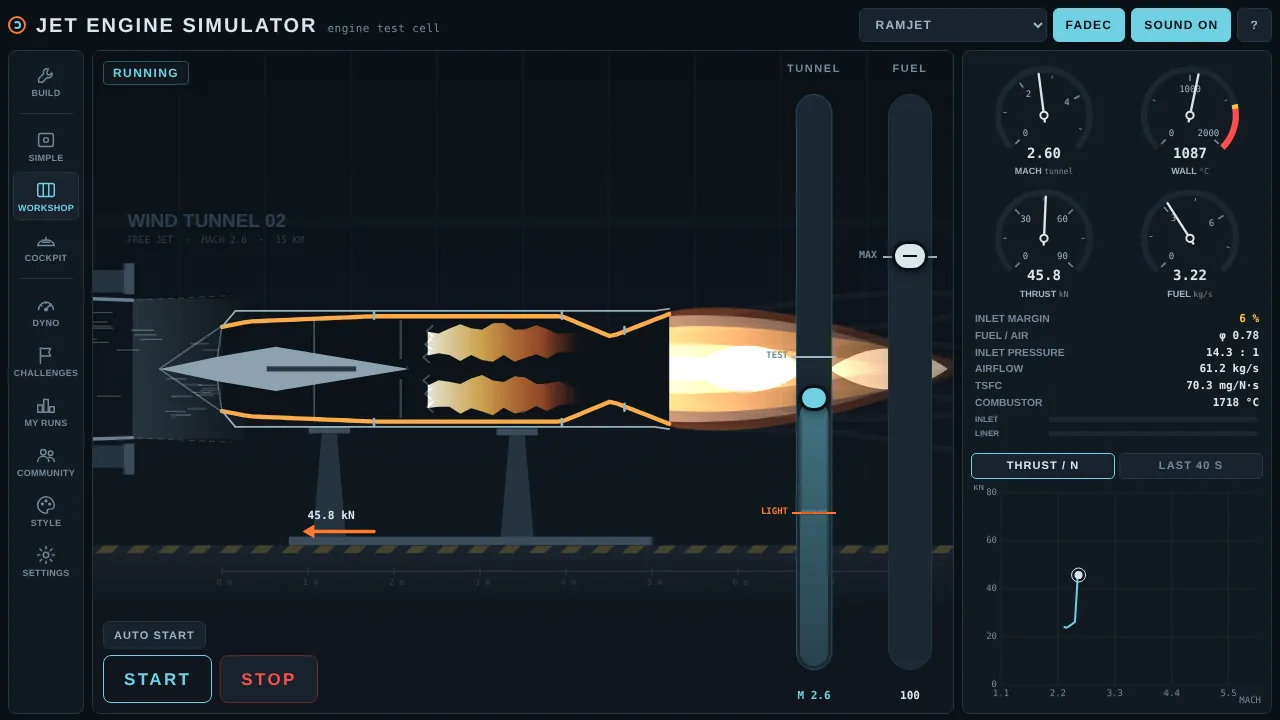
How a ramjet works
A ramjet does a jet engine's job without a compressor or turbine. At supersonic speed the shape of the inlet slows the incoming air through shock waves, and slowing air down raises its pressure. That "ram" compression replaces the compressor. Kerosene is sprayed in behind flame holders and burns like a giant afterburner, and the hot gas leaves through the nozzle faster than it came in.
The catch: with no compressor, a ramjet makes no thrust standing still. It has to be boosted or carried up to speed first, which is why ramjets are found on missiles and test vehicles, and why the game puts its ramjet in a wind tunnel instead of on the thrust stand.
Inlet shocks
How much pressure the inlet keeps depends on how it slows the air. A single, straight-on shock (a "pitot" inlet) keeps only about a third of the available pressure at Mach 3. Ramps that turn the flow through several weaker, angled shocks keep much more. In the game you choose the number of shocks in the Design office.
An inlet is also designed for one speed. Below its design Mach number it spills air around the lip; above it, the shocks move inside the lip and cost pressure.
Unstart and buzz
Burning fuel raises the pressure the nozzle throat needs to pass the flow, and the inlet has to supply it. With pressure to spare, the extra is lost in a stronger final shock (supercritical running). Short of it, the inlet spills air to match (subcritical running). In the game, once about 15 % of the air is being spilled the shock starts to buzz: an unstart. Flow and pressure collapse, thrust drops, and a buzzing inlet shakes itself apart if you leave it there.
Starting it in the game
- Run the wind tunnel up towards Mach 2.6. In the game a ramjet will not light below Mach 1.5, and it flames out below Mach 1.0: there is too little ram pressure.
- Switch on Ignition, then Fuel. There is no starter: a ramjet has nothing to spin.
- Bring the fuel up slowly and watch the inlet margin. Too much fuel unstarts the inlet.
Auto start does this for you, and with FADEC on the engine relights itself after a flameout and refuses to light when the tunnel is too slow.
The numbers
At the standard test (Mach 3, 15 km, kerosene fuel) the game's Ramjet makes 78.4 kN from an engine of 242 kg, a thrust-to-weight ratio of 33.1 that no turbine engine comes close to. The price is fuel: it burns 69.3 mg/N·s, almost three times the Training turbojet's 25.0 mg/N·s.
| Engine | Thrust | Afterburner | Fuel at 70 % | Spool-up | Mass |
|---|---|---|---|---|---|
| RamjetFree | 78.4 kN | – | 69.3 mg/N·s | – | 242 kg |
| ScramjetPro | 26.2 kN | – | 39.1 mg/N·s | – | 520 kg |
Things to try
- Light the Ramjet at Mach 2.6, then run the tunnel up to Mach 3 and beyond and watch thrust and wall temperature.
- Slow the tunnel down with full fuel and watch the inlet margin shrink until it buzzes.
- In the Design office, change the number of inlet shocks and compare the pressure the inlet keeps.