What "supersonic combustion" means
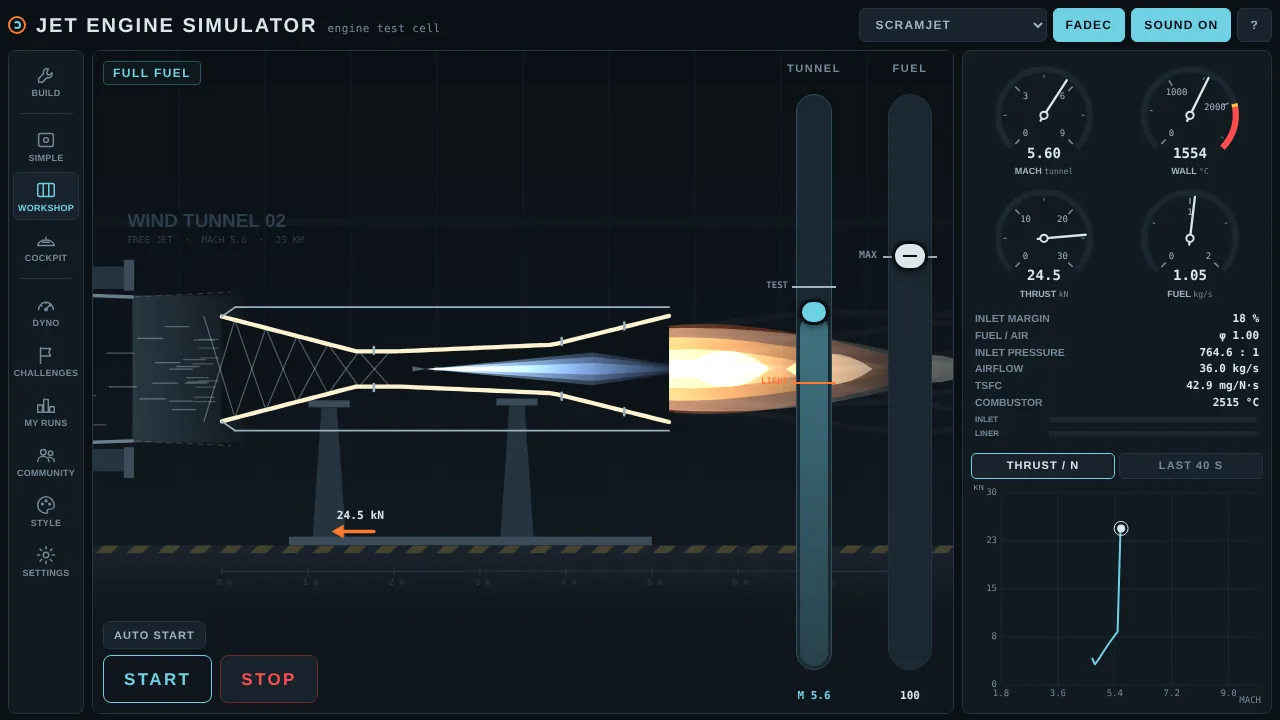
A ramjet slows the incoming air to below the speed of sound before burning fuel in it. At Mach 5 or 6 that stops working well: slowing air down from such a speed heats it so much that the combustor and walls suffer, and the shock system throws away a large part of the pressure. A scramjet (supersonic combustion ramjet) keeps the flow supersonic all the way through. Its inlet ramps squeeze the air with angled shocks without slowing it below Mach 1, and the fuel has to mix and burn in roughly a thousandth of a second.
That is why scramjets burn hydrogen: it lights and burns very fast, and it carries about 120 MJ of energy per kilogram, almost three times as much as kerosene.
The isolator
Burning fuel raises the pressure in the combustor, and that pressure tries to push forward into the inlet. Behind the ramps sits an isolator, a short duct that holds the pressure back so the inlet stays started. In the game's Design office you set the inlet ramps and the isolator length.
Thermal choking and unstart
Adding heat to a supersonic flow slows it down towards Mach 1. Add too much for the speed of the air in the combustor and the flow chokes: this limit (the Rayleigh limit) is where the shocks are pushed out of the inlet and the engine unstarts. Flow and thrust collapse in an instant. In the game a scramjet flames out the moment its inlet unstarts (a ramjet can ride out a short buzz). The inlet restarts once the flame is out, and with FADEC on the engine computer pulls the fuel back and relights it; without FADEC that is your job.
Hot walls
At Mach 6 the air at the inlet's leading edges stagnates against the metal and heats it, and the combustor liner sits next to burning hydrogen. The game tracks the hottest wall on the WALL gauge. The fuel cools the walls on its way in, and an overheated wall burns through.
Starting it in the game
- Run the wind tunnel up towards Mach 5.6. In the game a scramjet will not light below Mach 4.5, and it flames out below Mach 3.8.
- Switch on Ignition, then Fuel, and bring the fuel up slowly while you watch the inlet margin and the wall temperature.
- With FADEC on, the engine computer trims the fuel to hold the inlet margin and the wall temperature for you.
The numbers
At the standard test (Mach 6, 25 km, hydrogen) the game's Scramjet makes 26.2 kN and burns 39.1 mg/N·s. Measured by mass, that is less fuel per newton than the kerosene Ramjet needs at Mach 3, mostly because each kilogram of hydrogen carries so much more energy.
| Engine | Thrust | Afterburner | Fuel at 70 % | Spool-up | Mass |
|---|---|---|---|---|---|
| ScramjetPro | 26.2 kN | – | 39.1 mg/N·s | – | 520 kg |
| RamjetFree | 78.4 kN | – | 69.3 mg/N·s | – | 242 kg |
Things to try
- Light the Scramjet at Mach 5.6, then raise the tunnel speed and watch the wall temperature climb.
- With FADEC off, push the fuel lever up until the inlet unstarts, and see how sudden it is.
- In the Design office, change the isolator length and the number of inlet ramps, and compare how much fuel each version takes before it unstarts.