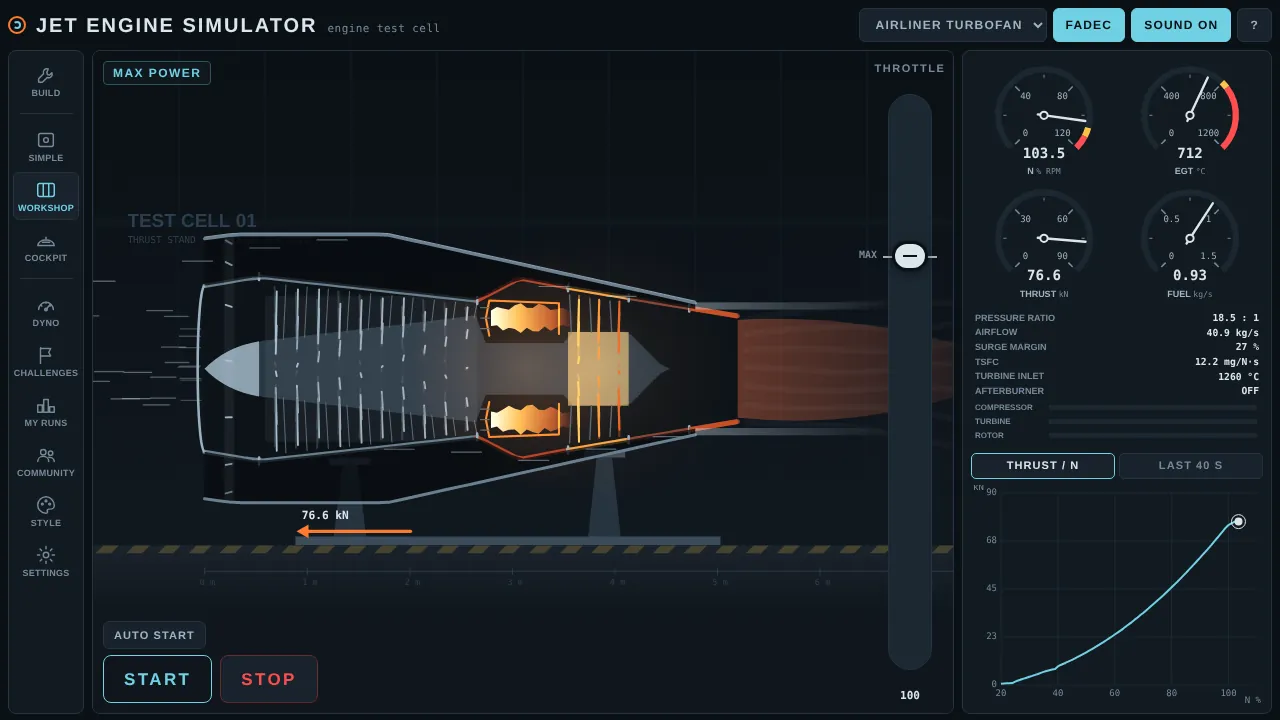
How a turbofan works
At its centre a turbofan is a turbojet: compressor, combustor, turbine, nozzle. The difference is a large fan at the front, also driven by the turbine. Only part of the air the fan moves goes into the core. The rest flows around it through the bypass duct and leaves as a second, cooler jet.
The bypass ratio is how much air goes around the core for each kilogram that goes through it. Fighter engines are below 1. Airliner engines from the 1970s onward are around 5, and the newest large engines are above 10.
Why bypass air saves fuel
Thrust is mass flow times the change in velocity, so there are two ways to make the same thrust: speed up a little air a lot, or a lot of air a little. Every bit of speed left in the jet behind the aircraft is energy that burned fuel but did not push the aircraft. A big, slow jet wastes less of it than a small, fast one, so its propulsive efficiency is higher.
ηp = 2 / (1 + Vjet / V0)F thrust, ṁ air mass flow, Vjet jet speed, V0 flight speed, ηp propulsive efficiency. The closer the jet speed is to the flight speed, the higher ηp. Try it in the jet thrust calculator.
In the game, the Airliner turbofan (bypass ratio 5) burns 11.2 mg/N·s at 70 % power on the dyno, less than half the 25.0 mg/N·s of the Training turbojet. The slower jet is also why turbofans are quieter.
Low bypass and afterburners
A fighter needs a fast jet for supersonic flight, so its turbofan keeps the bypass ratio low and adds an afterburner. The game's Fighter turbofan has a bypass ratio of 0.5 and makes 67.5 kN dry and 87.3 kN with the afterburner lit.
Turbofans in the game
The same standard dyno test for every engine: sea level, standard day, FADEC on. The Training turbojet is included for comparison.
| Engine | Thrust | Afterburner | Fuel at 70 % | Spool-up | Mass |
|---|---|---|---|---|---|
| Airliner turbofanPro | 76.7 kN | – | 11.2 mg/N·s | 8.2 s | 1,417 kg |
| Fighter turbofanPro | 67.5 kN | 87.3 kN | 22.4 mg/N·s | 10.8 s | 1,663 kg |
| Training turbojetFree | 55.6 kN | 72.2 kN | 25.0 mg/N·s | 15.3 s | 1,577 kg |
How the game models the fan
The fan stream is a second airstream driven from the engine's shaft. Its airflow and pressure ratio follow the engine's corrected speed, and that air expands to ambient pressure through its own nozzle. Real turbofans put the fan on a separate, slower low-pressure spool with its own turbine; the game keeps one spool so it stays quick and readable. The About page lists every simplification.
Things to try
- Run the dyno on the Airliner turbofan and then the Training turbojet, and compare fuel use at 70 % power.
- In the Design office (Pro), raise the bypass ratio step by step and watch thrust and fuel use on each dyno sheet.
- Take the Fighter turbofan to full power, then light the afterburner and watch the fuel flow jump.