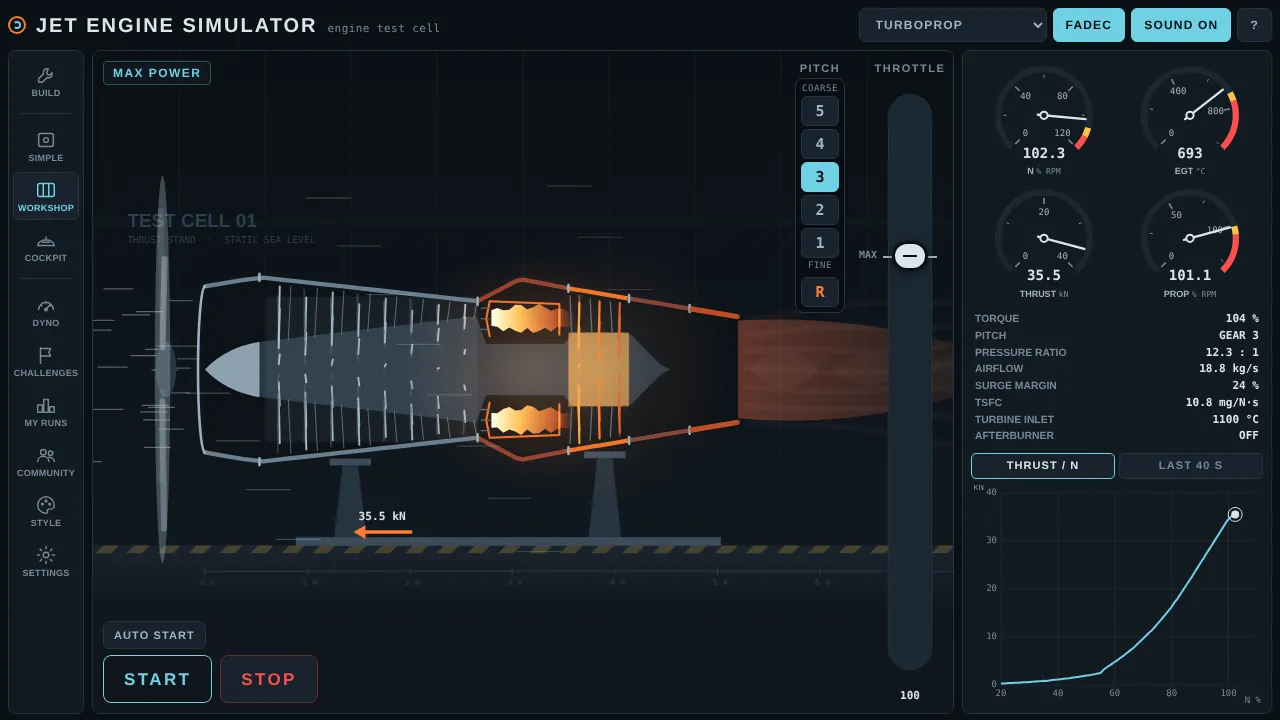
How a turboprop works
The core of a turboprop is a small gas turbine: compressor, combustor and turbine. Instead of making a fast jet, its turbines take out almost all of the energy as shaft power. A reduction gearbox slows that shaft down to drive the propeller, which makes most of the thrust. The exhaust adds only a little.
In the game the propeller is driven by a free turbine: the core makes the shaft power, and the blade angle decides how fast the propeller turns with it.
Propeller pitch, used like gears
The angle of the propeller blades is the pitch. Fine pitch takes small bites of air, so the propeller spins up easily: good for take-off. Coarse pitch takes big bites at a lower speed: good for cruise. In flight the oncoming air unloads the blades, so a faster aircraft needs a coarser pitch, like a higher gear.
- The game gives the Turboprop five pitch positions plus reverse (R).
- A propeller works best near its rated speed. A slow, lugging propeller wastes power, so match the pitch to the power you are making.
- Reverse pitch pushes air forwards to brake after landing. Reversing under power wrecks the gearbox, in the game as in life.
Why turboprops suit slower aircraft
A propeller moves a huge mass of air and speeds it up only a little, which is the most fuel-efficient way to make thrust at low speed (see turbojet vs turbofan for why). As speed rises, the blade tips approach the speed of sound and lose efficiency, which is why turboprops are used on regional airliners, transports and trainers rather than on fast jets.
In the game's dyno test the Turboprop makes 35.7 kN of static thrust and burns 10.6 mg/N·s at 70 % power, the lowest fuel use of any ready-made engine. Its dyno sheet also quotes thrust horsepower at 300 knots, the usual way to compare propeller and jet engines.
| Engine | Thrust | Afterburner | Fuel at 70 % | Spool-up | Mass |
|---|---|---|---|---|---|
| TurbopropPro | 35.7 kN | – | 10.6 mg/N·s | 6.2 s | 876 kg |
| Airliner turbofanPro | 76.7 kN | – | 11.2 mg/N·s | 8.2 s | 1,417 kg |
| Training turbojetFree | 55.6 kN | 72.2 kN | 25.0 mg/N·s | 15.3 s | 1,577 kg |
Things to try
- Start the Turboprop in fine pitch, bring the power up, then shift towards coarse and watch the propeller speed.
- Leave it in coarse pitch at low power and see the propeller lug down and the thrust fall.
- At idle, try reverse pitch, then compare with what happens if you add power in reverse.