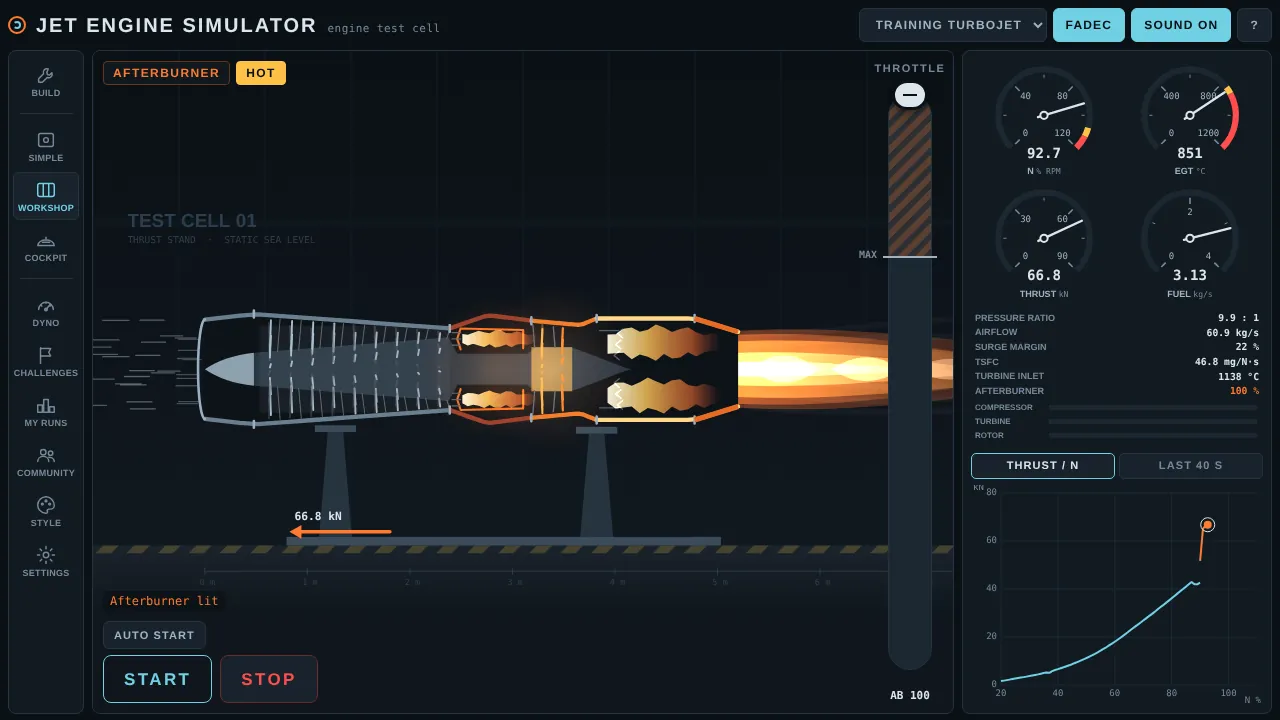
What a turbojet is
A turbojet is the simplest jet engine with moving parts. Every bit of air that enters goes through the core: the compressor squeezes it, the combustor burns fuel in it, the turbine takes out just enough energy to keep the compressor spinning, and the nozzle turns what is left into a fast jet. Thrust is the reaction to pushing that jet backwards.
Because all of the thrust comes from one small, very fast jet, a turbojet is compact and works well at high speed, but it is thirsty and loud at low speed. That is why airliners moved to turbofans, while turbojets lived on in early jet aircraft, missiles, drones and model jets.
Starting a turbojet
- Starter. A starter spins the rotor first, because the compressor has to move air before anything can burn.
- Ignition and fuel. Once the rotor is turning fast enough, the igniters fire and fuel is sprayed into the combustor. In the game, fuel before roughly 13 % rotor speed gives a hot start: too little air for the flame.
- Light-off. The flame catches and the exhaust gas temperature (EGT) jumps. The turbine starts to help the starter.
- Accelerate to idle. The engine becomes self-sustaining and settles at idle. Too much fuel too early overheats it; too little and it hangs below idle.
With FADEC (the engine computer) on, the game schedules the fuel and cuts it on a hot or hung start before the turbine is hurt. Switch FADEC off, or pick the Hot rod, and you meter the fuel yourself.
The afterburner
An afterburner (reheat) sprays extra fuel into the hot gas behind the turbine and burns it in the jet pipe. The nozzle opens wider to let the hotter gas out, and thrust jumps, at a large cost in fuel. In the game's dyno test the Training turbojet makes 55.6 kN dry and 72.2 kN with the afterburner lit.
Turbojets in the game
Every number below comes from the same standard dyno test: sea level, standard day, FADEC on. Fuel use is measured at 70 % power, and spool-up is the time from idle to 95 % of full thrust after the throttle is snapped open.
| Engine | Thrust | Afterburner | Fuel at 70 % | Spool-up | Mass |
|---|---|---|---|---|---|
| Training turbojetFree | 55.6 kN | 72.2 kN | 25.0 mg/N·s | 15.3 s | 1,577 kg |
| Economy cruiserFree | 45.5 kN | – | 19.9 mg/N·s | 9.4 s | 1,161 kg |
| 1950s turbojetPro | 38.5 kN | – | 28.9 mg/N·s | 19.1 s | 1,085 kg |
| InterceptorPro | 77.6 kN | 107.5 kN | 25.0 mg/N·s | 13.0 s | 2,281 kg |
| SupercruiserPro | 72.0 kN | 95.2 kN | 23.4 mg/N·s | 18.6 s | 2,359 kg |
| Record breakerPro | 99.9 kN | 117.7 kN | 24.5 mg/N·s | 16.6 s | 2,665 kg |
| Heavy lifterPro | 87.6 kN | 121.6 kN | 17.6 mg/N·s | 20.5 s | 2,727 kg |
| Drone micro-jetPro | 11.4 kN | – | 31.1 mg/N·s | 6.2 s | 287 kg |
| Hot rodPro | 15.7 kN | 15.9 kN | 26.0 mg/N·s | 8.3 s | 819 kg |
Compare the Economy cruiser with the 1950s turbojet: a higher pressure ratio and a hotter, better turbine let the Economy cruiser burn about a third less fuel for each newton of thrust. The ceramic hot section of the Record breaker runs hotter still and gives the most dry thrust of any turbojet here. The Brayton cycle calculator shows the same effect with textbook numbers.
Things to try
- Start the Training turbojet and watch EGT peak during light-off, then settle at idle.
- Snap the throttle to full and watch the rotor speed (N1) and thrust lag behind the lever: that delay is spool-up.
- Open the Design office and raise the compressor pressure ratio, then run the dyno again and compare the fuel use.
- Turn FADEC off and try a manual start. Bring the fuel in too early and the turbine overheats.