Why there is fuel left to burn
A jet engine's main combustor could burn far more fuel than it does. What stops it is the turbine right behind it: the blades can only take so much heat, so the engine burns only part of the oxygen in the air and keeps the gas cool enough for the turbine to survive (the turbine guide explains how close to the limit that is). The gas leaving the turbine is still full of unused oxygen. An afterburner, called reheat in Britain, sprays fuel into that gas behind the turbine, where there are no blades left to melt, and burns it.
Flame holders and spray bars
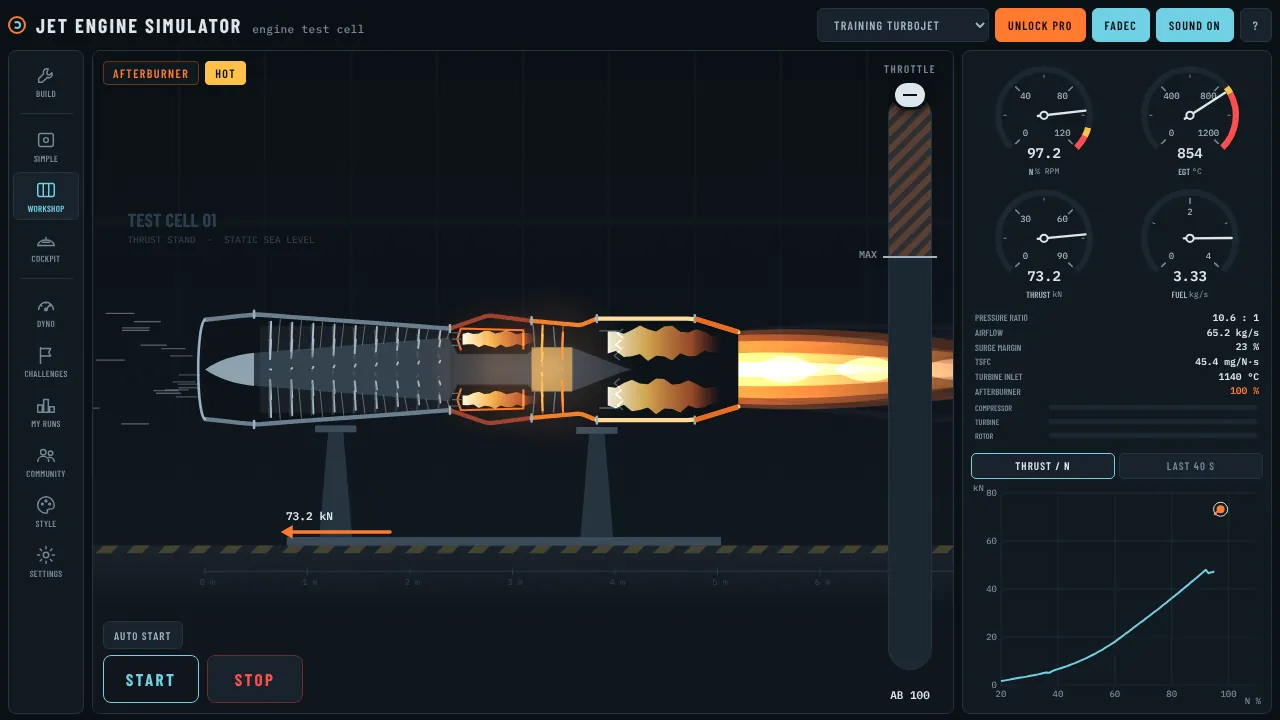
The gas in the jet pipe is moving fast, faster than a flame can travel through it, so a free flame would simply blow out of the back. Rings of spray bars inject the fuel, and V-shaped flame holders just behind them create sheltered pockets of slow, swirling gas where the flame can anchor itself. The burning then spreads across the whole jet pipe, which is long so the fuel has time to burn completely before it reaches the nozzle.
Why the nozzle has to open
Burning fuel in the jet pipe makes the gas much hotter, and hotter gas takes up more room. If the nozzle stayed the same size, the extra gas would back up, the pressure behind the turbine would rise, and the turbine would stop doing its job: the engine would slow down, run hotter and could surge. So every afterburning engine has a variable nozzle made of overlapping petals that opens as the afterburner lights, keeping the turbine's back-pressure about where it was. That is why a fighter's exhaust visibly widens when the pilot selects afterburner.
How much thrust, and at what price
The hotter gas leaves the nozzle much faster, and thrust comes from that speed. Military engines commonly gain around half again as much thrust with the afterburner lit, sometimes more. The price is fuel: an afterburner turns out its extra thrust very inefficiently, so the engine's fuel flow climbs to several times its dry figure. That is why fighters use it for take-off, combat and pushing through the speed of sound, and cruise without it. A few aircraft, such as the F-22, are designed to supercruise, flying faster than sound without the afterburner. Concorde used its reheat only for take-off and to accelerate through Mach 1, then shut it off for the long supersonic cruise.
Afterburners also work in low-bypass turbofans, where they burn fuel in the mixed core and bypass air. The bypass air is cool and oxygen-rich, so the gain can be even larger than in a turbojet.
Afterburners in the game
The game's afterburner lights only when the engine is running at full dry power, above 88 % N, and not surging. A pilot flame catches first, and about half a second later the main flame lights and the nozzle starts to open. In the Design office you set two things: the afterburner fuel rate (grams of fuel per kilogram of core air) and how far the nozzle opens. Too little opening and the afterburner chokes the turbine; too much fuel and the jet pipe liner overheats and burns through. The liner's limit depends on the hot-section material you choose.
Here is what the afterburner adds on four of the game's engines, from the standard dyno test (dry thrust, then afterburner thrust):
| Engine | Thrust | Afterburner | Fuel at 70 % | Spool-up | Mass |
|---|---|---|---|---|---|
| Training turbojetFree | 55.6 kN | 71.5 kN | 25.0 mg/N·s | 15.3 s | 1,577 kg |
| InterceptorPro | 77.6 kN | 108.6 kN | 25.0 mg/N·s | 13.0 s | 2,281 kg |
| SupercruiserPro | 72.0 kN | 95.8 kN | 23.4 mg/N·s | 18.6 s | 2,359 kg |
| Fighter turbofanPro | 67.5 kN | 87.3 kN | 22.4 mg/N·s | 10.8 s | 1,663 kg |
The free Training turbojet goes from 55.6 kN dry to 71.5 kN with the afterburner lit. The game's Afterburner kick challenge asks for an afterburner that adds at least 40 % thrust, which takes a little tuning in the Design office.
Things to try
- Run the Training turbojet to full power, press PgUp to light the afterburner, and watch the nozzle open and the fuel gauge jump.
- In the Design office, close the afterburner nozzle opening right down and run it again: the turbine is choked and the engine loses speed.
- Raise the afterburner fuel rate step by step and run the dyno each time. Thrust climbs until the liner can no longer take the heat.