The short answer
A ramjet slows the incoming air to well below the speed of sound, burns fuel in that slow, high-pressure air and blows it out of a nozzle. A scramjet (supersonic combustion ramjet) does the same job without ever slowing the air below Mach 1. That makes the scramjet the only air-breathing engine that keeps working at around Mach 6 and above, but it is far harder to build and to keep lit.
Side by side
| Ramjet | Scramjet | |
|---|---|---|
| Air speed in the combustor | Subsonic (well below Mach 1) | Supersonic (above Mach 1) |
| Useful flight speed | Roughly Mach 2 to 5 | Roughly Mach 5 and above |
| Thrust standing still | None. It must be boosted to speed | None. It needs even more speed to start |
| Typical fuel | Kerosene-type jet fuel | Hydrogen, or a cooled hydrocarbon fuel |
| Main way it fails | Inlet unstart and buzz | Thermal choking that unstarts the inlet |
| Where it has flown | Missiles and test vehicles for decades | Short research flights |
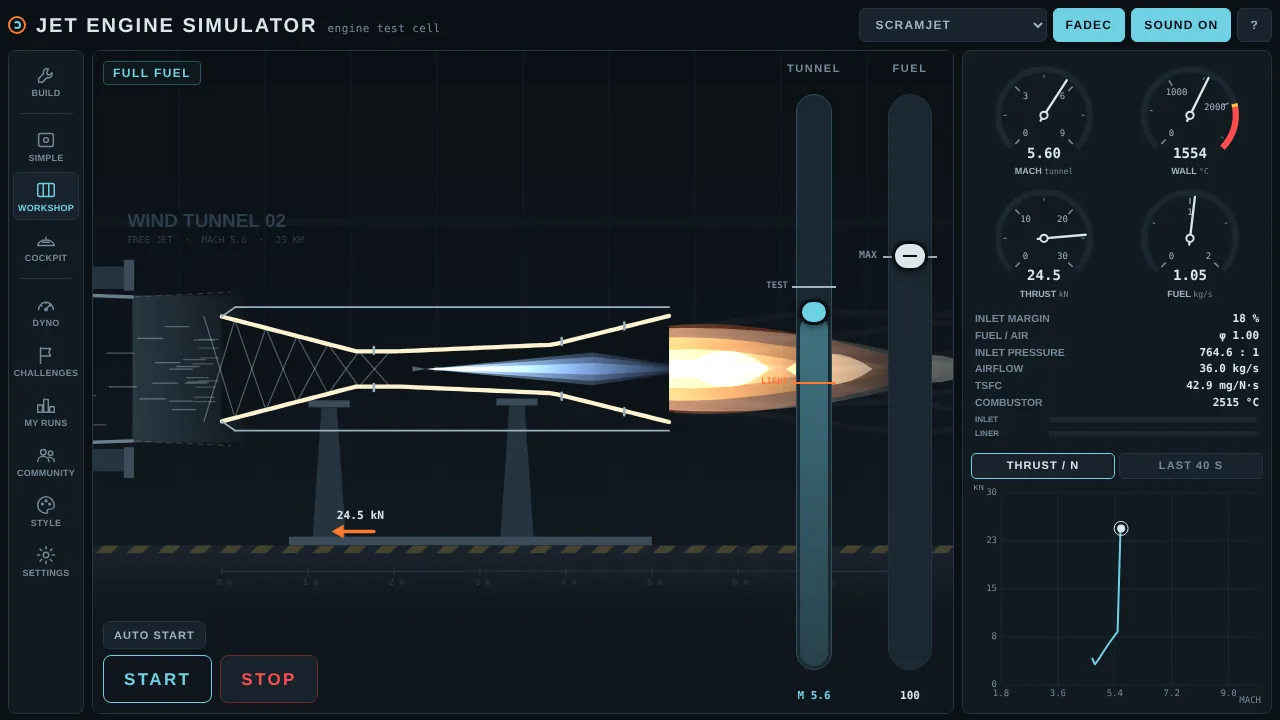
| In the game | Free, tested at Mach 3 and 15 km | Pro, tested at Mach 6 and 25 km |
Why ramjets stop working near Mach 5
Slowing air down turns its speed into pressure and heat. At Mach 3 that is exactly what a ramjet wants: the inlet's shocks give it a pressure rise that would take a large compressor to match. At Mach 6, slowing the air to a crawl heats it so much that there is little room left to add heat by burning fuel, the walls are pushed to their limits, and the shock system throws away much of the pressure it was meant to recover. Past roughly Mach 5, keeping the flow supersonic and burning the fuel on the move becomes the better deal, and that is the scramjet.
Why scramjets usually burn hydrogen
In a scramjet the air crosses the combustor in about a millisecond, so the fuel has to mix and burn almost instantly. Hydrogen lights and burns very quickly, and each kilogram carries about 120 MJ of energy, almost three times as much as kerosene (about 43 MJ). The game uses exactly those two values: kerosene for the Ramjet and hydrogen for the Scramjet. Hydrogen is also a superb coolant, so it is often run through the hot walls before it is burned.
How each one fails
Both engines depend on the inlet staying started, with its shock pattern in the right place. In a ramjet, too much fuel or too slow a flight speed pushes the shocks out of the inlet: flow and thrust collapse, and the shocks can bang back and forth in a violent buzz. In a scramjet, adding heat to the supersonic stream slows it towards Mach 1; add too much and the flow chokes, the pressure rise runs forward through the isolator, and the inlet unstarts in an instant. In the game a ramjet can ride out a short buzz, while a scramjet flames out the moment it unstarts.
Where they have flown
Ramjets have powered missiles and test vehicles since the 1950s, the British Bloodhound surface-to-air missile among them, and modern supersonic cruise missiles still use them. Some aircraft engines borrow the idea: near its top speed the SR-71's inlets did most of the compressing, and part of the air skipped the engine core and went straight to the afterburner, so the engines behaved partly like ramjets. Scramjets have flown only in short experiments. NASA's unmanned X-43A reached about Mach 9.6 on hydrogen in 2004, and the X-51A WaveRider flew under scramjet power for about three and a half minutes at around Mach 5 on hydrocarbon fuel in 2013.
The game's two engines, measured
At its standard test (Mach 3, 15 km, kerosene) the game's Ramjet makes 78.4 kN from an engine of 242 kg. The Scramjet's test is Mach 6 at 25 km on hydrogen, where it makes 26.2 kN. Measured by mass, the Scramjet burns less fuel per newton (39.1 mg/N·s against 69.3 mg/N·s), mostly because each kilogram of hydrogen carries so much more energy.
| Engine | Thrust | Afterburner | Fuel at 70 % | Spool-up | Mass |
|---|---|---|---|---|---|
| RamjetFree | 78.4 kN | – | 69.3 mg/N·s | – | 242 kg |
| ScramjetPro | 26.2 kN | – | 39.1 mg/N·s | – | 520 kg |
In the game's wind tunnel the Ramjet lights from Mach 1.5 and flames out below Mach 1.0. The Scramjet will not light below Mach 4.5 and flames out below Mach 3.8. Those floors are the clearest picture of the difference: the scramjet simply cannot work where the ramjet is happiest.
Things to try
- Light the free Ramjet, then run the tunnel up past Mach 4 and watch the wall temperature climb as the ram heating grows.
- Turn FADEC off on the Ramjet and push the fuel until the inlet unstarts and buzzes. Then do the same on the Scramjet and compare how sudden it is.
- Read the afterburner guide: a ramjet's combustor is a very close cousin of an afterburner.