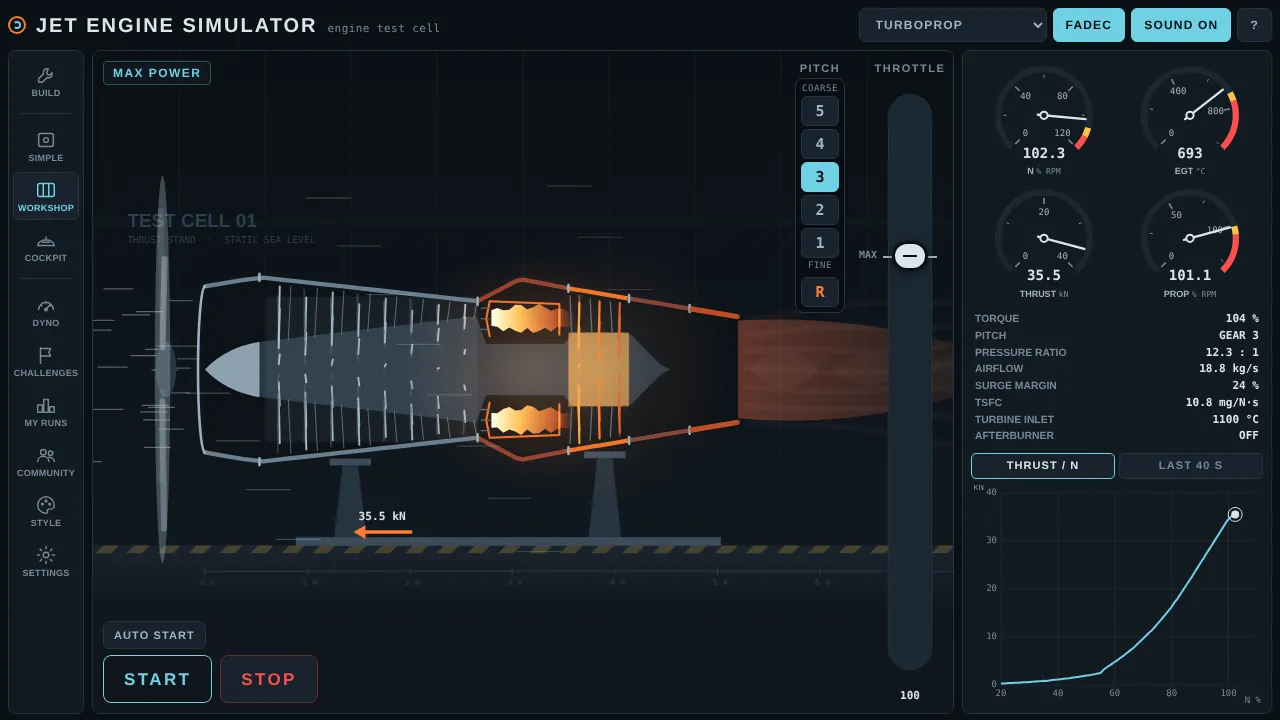
The same idea, taken to two extremes
The most fuel-efficient way to make thrust is to push a lot of air backwards gently, rather than a little air very hard (the thrust calculator shows why: propulsive efficiency is highest when the jet is only a little faster than the aircraft). A turbofan does this with a large fan in a duct, moving several times more air around its core than through it. A turboprop takes the idea further: its propeller moves a far bigger column of air, so gently that most of the thrust comes from the propeller and very little from the exhaust.
The catch is speed. A propeller's blade tips move both around and forward, and as the aircraft speeds up the tips approach the speed of sound, where shock waves form and efficiency falls away. A turbofan's duct slows the air down before it reaches the fan, and its shorter, many-bladed fan copes with high speed much better. So the propeller wins when flying slower, and the fan wins when flying fast.
Side by side
| Turboprop | Turbofan (airliner) | |
|---|---|---|
| What makes the thrust | An open propeller, driven through a gearbox | A ducted fan plus the core's jet |
| Most efficient cruise speed | Up to roughly 650 km/h | Around 800 to 900 km/h (Mach 0.78 to 0.85) |
| Typical cruise altitude | Lower, often around 7 to 8 km | Higher, around 10 to 12 km |
| Fuel use | Lowest on short routes | Better on longer routes, where its speed counts |
| Noise | Distinctive drone in the cabin | Quieter in the cabin |
| Short, rough runways | Good: strong thrust at low speed, and reverse pitch for braking | Needs longer, cleaner runways |
| Typical aircraft | ATR 72, Dash 8, C-130 Hercules | Boeing 737, Airbus A320, Boeing 787 |
Why airlines use both
On a short regional hop, an aircraft spends much of the flight climbing and descending, and a faster cruise saves only minutes. A turboprop burns noticeably less fuel per seat on those routes, and copes well with smaller airports. On longer flights the turbofan's extra speed and altitude pay off: more trips per day, smoother air above most weather, and fuel use that compares well once the cruise is long. That is why the same airline often flies turboprops on short regional routes and jets everywhere else.
The line between the two is moving. Engine makers are testing open-fan designs, large unducted fans on a gas turbine core that aim to keep much of a propeller's efficiency at close to jet speeds.
Measured in the game
The game's standard dyno test runs both engines on the same thrust stand at sea level, standing still:
| Engine | Thrust | Afterburner | Fuel at 70 % | Spool-up | Mass |
|---|---|---|---|---|---|
| TurbopropFree | 35.7 kN | – | 10.6 mg/N·s | 6.2 s | 876 kg |
| Airliner turbofanFree | 71.2 kN | – | 10.9 mg/N·s | 11.0 s | 1,339 kg |
Standing still, the Turboprop makes 35.7 kN against the Airliner turbofan's 71.2 kN, but it is a much smaller, lighter engine (876 kg against 1,339 kg), and at 70 % power it burns the least fuel of any ready-made engine: 10.6 mg/N·s against 10.9 mg/N·s. Standing still is where a propeller looks its best, though. In flight a propeller's thrust falls away with speed faster than a turbofan's, which is why the turbofan takes over at airliner speeds.
The Turboprop also brings something no turbofan has: pitch gears. Fine pitch at full power overspeeds the propeller, coarse pitch at full power over-torques the gearbox, and reverse under power wrecks it.
Things to try
- Run both free engines on the dyno and compare their sheets: thrust, weight, spool-up time and fuel use.
- On the Turboprop, shift from gear 3 to gear 1 at full power with FADEC off. That is the Money shift challenge, and the propeller does not survive it.
- Read turbojet vs turbofan for the other end of the scale: no fan at all.